WHAT TO EXPECT
- What You Need to Know About the South African Driving Test
- How to Prepare for Your K53 Driving Test
- K53 Yard Test Tips
- K53 Road Test Tips
- Common Mistakes That Can Make You Fail
- How to Stay Calm During Your Driving Test
- What to Do the Day Before Your Driving Test
- What to Do on the Morning of Your Test
- What Happens If You Fail Your Driving Test?
- Frequently Asked Questions
The best way to pass your South African driving test is to practise the K53 procedures correctly, master the yard manoeuvres, practise observation and road positioning, and get comfortable driving in real traffic. Don’t just practise driving around. Practise the specific skills you will be assessed on.
Getting your driver’s licence in South Africa can feel stressful.
You practise for weeks. You spend money on driving lessons. You learn the K53 system. Then the test day arrives and suddenly you forget everything you thought you knew.
But passing your driving licence test is not about being a perfect driver. It is about being prepared, calm and consistent.
What You Need to Know About the South African Driving Test
The South African practical driving test is based on the K53 system and includes a yard test and a road test. The test is designed to assess your ability to handle the vehicle, follow traffic rules and deal with real traffic situations.
The official K53 practical driving test documentation describes the test as consisting of a yard test and a road test, assessing vehicle handling, obedience to traffic rules and the ability to cope with traffic situations.
So, how do you actually give yourself the best chance of passing? Let’s break it down.
How to Prepare for Your K53 Driving Test
Before you start practising, understand what the test involves. For a normal light motor vehicle, the practical test has two main parts: the yard test and the road test.
Learn the K53 system
One of the biggest mistakes learners make is treating K53 like a list of movements they need to memorise. K53 is more than that. You need to understand the procedures and develop the habit of doing them correctly.
For example, when changing lanes, you should not simply look in your mirror and move over. You need to follow the correct observation and signalling procedure. The same applies to intersections, stopping, turning, moving off and other situations. The goal is to make these actions automatic.
Practise the yard test
Do not wait until the week of your test to start practising the yard manoeuvres. Practise them repeatedly. The goal is not to rush. Slow and controlled is better than fast and messy.
Practise driving on real roads
Knowing one familiar road does not mean you are ready for the test. Try driving in different environments such as quiet residential streets, busy roads, intersections, traffic circles, and roads with pedestrians.
Work on your weak points
If you make the same mistake during every lesson, don’t just keep driving and hope it disappears. Stop and fix it. If you struggle with clutch control, spend more time practising moving off smoothly. Your lessons should target your weaknesses.
K53 Yard Test Tips
The yard test checks things such as vehicle control and specific manoeuvres. Depending on your test and vehicle, this can include:
- Pre-trip vehicle inspection
- Starting procedures
- Incline start (hill start)
- Alley docking
- Parallel parking
- Turning in the road
- Stopping procedures
Your instructor should teach you the exact procedure required for your test. Practise until you can perform each manoeuvre without panicking.
K53 Road Test Tips
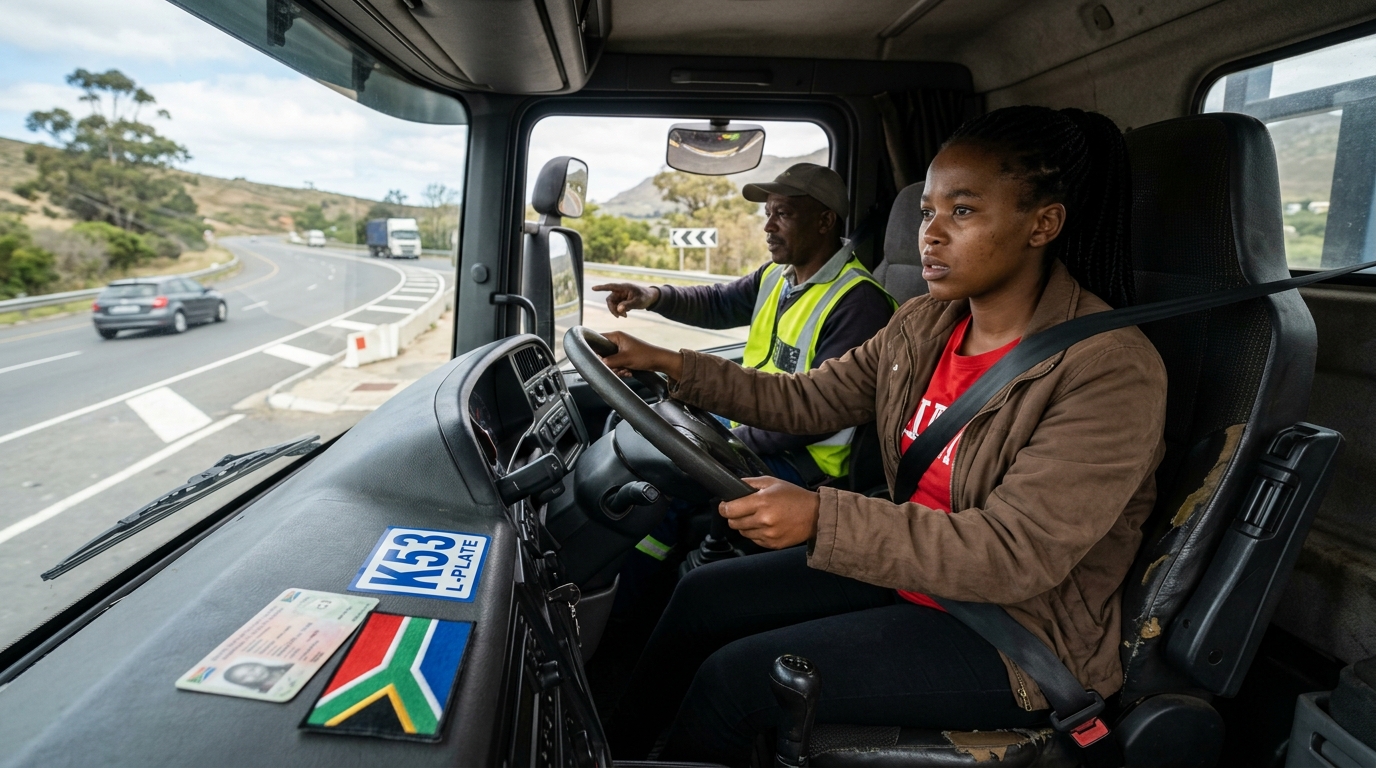
The road test checks how you drive in actual traffic and whether you follow the required procedures and rules. This is one of the most important parts of driving. Do not only focus on where the car is going. You need to constantly be aware of what is happening around you.
Practise checking:
- Your mirrors
- Blind spots
- Indicating correctly before manoeuvres
- Intersections and traffic circles
- Lane changes
- Following distances and stopping
You should eventually be checking your surroundings naturally rather than only doing it because you remembered that the examiner is watching.
Common Mistakes That Can Make You Fail
If you remember nothing else from this article, remember these common mistakes to avoid:
- Do not rush. Accelerating too quickly or rushing manoeuvres is a fast track to failing.
- Do not ignore observations. Failing to check mirrors and blind spots correctly is a major issue.
- Rolling stops. Always come to a complete stop at stop signs.
- Incorrect positioning and hitting kerbs. Especially during yard manoeuvres.
- Do not forget your procedures.
- Do not drive differently just because the examiner is sitting next to you.
The exact scoring and immediate-failure rules are based on the prescribed K53 testing procedure, so make sure your instructor is teaching you the current requirements for your vehicle class and testing centre.
How to Stay Calm During Your Driving Test
Your examiner is sitting next to you. Your heart is beating. You suddenly forget everything you’ve practised. This is where many learners get themselves into trouble. They become nervous and start driving differently from how they normally drive.
Take your time. Listen carefully to the examiner’s instructions. If you do not hear or understand an instruction, make sure you understand what you are being asked to do before proceeding.
If you make a small mistake, don’t panic. Making one mistake does not automatically mean you have failed. If you make a mistake, stay calm and continue driving safely. Do not let one mistake cause another five mistakes.
What to Do the Day Before Your Driving Test
The day before your test should not be an eight-hour driving marathon. You want to be confident, not exhausted.
Have a focused practice session. Go through the things you normally struggle with. Review your K53 procedures. Make sure you know where you need to go for your test. Then get some rest. Being tired and stressed on test day will not help you.
Make sure you have the documents you need. According to the South African Government, you need your learner’s licence, ID, required photographs, proof of residential address and booking fee when applying for a driving licence. You should also keep your booking receipt because it confirms your test date and time. Requirements can vary slightly by testing centre, so check with your DLTC beforehand.
What to Do on the Morning of Your Test
Keep things simple. Eat something if you normally eat breakfast. Drink some water. Give yourself enough time to get there. The government states that you must arrive at the DLTC at the specified testing time, where your documents will be checked before you proceed with the test.
Do not spend the entire morning watching scary TikTok videos about people failing their driving tests. Trust your preparation.
What Happens If You Fail Your Driving Test?
There is nothing embarrassing about needing more practice. If you do fail, use it as a learning opportunity. Ask your examiner where you went wrong, take extra lessons, and work specifically on those weaknesses before booking your next test.
Frequently Asked Questions
Can you fail your driving test for stalling?
Stalling once does not necessarily mean an immediate failure, depending on where and how it happens. However, repeatedly stalling or stalling in a dangerous position (like an intersection) will cause you to lose points or fail. The key is to restart the car calmly and safely.
What are the most common K53 mistakes?
Some of the most common mistakes include failing to check blind spots, rolling through stop signs, hitting the kerb during parking manoeuvres, rolling backwards on an incline start, and not using the parking brake correctly.
What should I take to my driving test?
You generally need your valid learner’s licence, your South African ID, the booking receipt, and the required fees for issuing the licence if you pass. Check with your specific DLTC for any additional requirements like photographs or proof of address.
What happens during the K53 yard test?
The yard test happens in a controlled area at the testing centre. You will perform a pre-trip inspection, and complete manoeuvres like alley docking, parallel parking, a three-point turn, and an incline start without hitting obstacles or rolling.
What happens during the K53 road test?
During the road test, the examiner will direct you along a route in normal traffic. You will be assessed on how you observe the road, use your mirrors, signal, change lanes, approach intersections, and obey traffic signs and speed limits.