WHAT TO EXPECT
Getting your learner’s licence is one of the most exciting milestones when you grow up in South Africa. It represents independence, freedom, and the first major step towards legally driving a car.
Many young people delay writing their learner's test because they feel nervous or assume they must pay thousands of rands to driving schools for theory lessons. The truth is much simpler: you can study on your own, pass on your very first try, and spend only the official government booking fees.
1. Understanding the Three Learner's Licence Codes
Before booking your test date, you need to know which code you are applying for. The minimum age depends directly on the vehicle category you intend to drive.
Many 17-year-olds do not realise they can already get their Code 2 licence for standard passenger cars. You do not need to wait until your 18th birthday to start driving legally with an instructor.
| Licence Code | Vehicle Types Covered | Min Age | Test Format | Approximate Fees |
|---|---|---|---|---|
| Code 1 | Motorcycles & scooters (up to 125cc at 16, over 125cc at 18) | 16 / 18 | Computerised touch-screen (CLLT) | R68 – R150 booking + R33 – R60 issue |
| Code 2 | Light motor vehicles, sedans, hatchbacks, bakkies (≤ 3,500 kg) | 17 | Computerised touch-screen (CLLT) | R68 – R150 booking + R33 – R60 issue |
| Code 3 | Heavy vehicles, trucks, buses (> 3,500 kg) | 18 | Computerised touch-screen (CLLT) | R68 – R150 booking + R33 – R60 issue |
2. The K53 Test Structure and Pass Marks
South African Driving Licence Testing Centres (DLTC) use the Computerised Learner's Licence Test (CLLT). You will sit at an automated touch-screen cubicle and answer multiple-choice questions in front of a computer.
The test contains between 64 and 68 questions split into three distinct categories. You must achieve the minimum pass mark in every single category:
- Rules of the Road: Approximately 28 to 30 questions. You need at least 22 correct answers (around 78%) to pass.
- Road Signs, Signals, and Markings: Approximately 28 questions. You need at least 23 correct answers (around 82%) to pass.
- Vehicle Controls: Exactly 8 questions. You must get at least 6 out of 8 correct. Because this section only has 8 questions, getting just 3 wrong means an immediate fail.
3. How to Study on Your Own (And Why You Don't Need Classes)
You do not need to pay expensive tutoring fees to pass the theory exam. The questions are standardised nationwide under the official K53 curriculum.
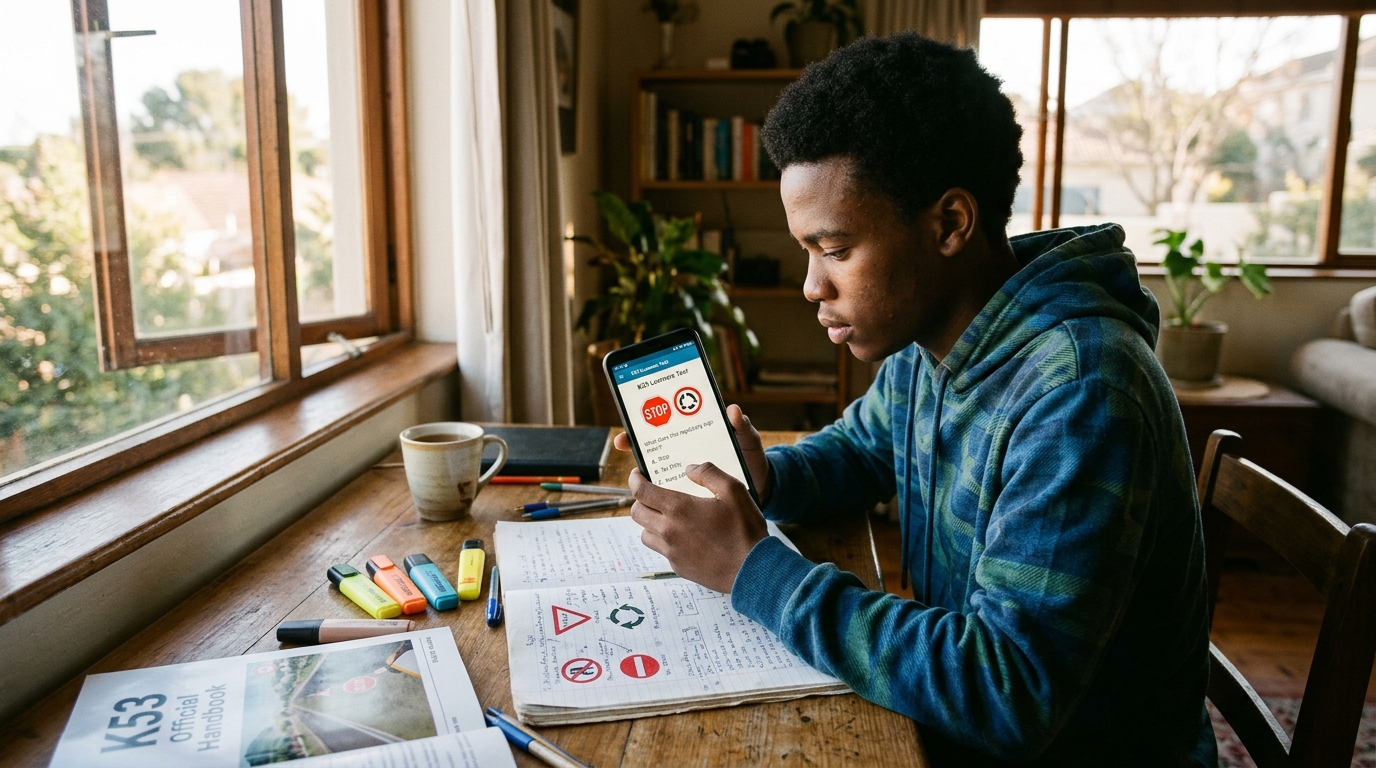
Download a reputable free app, such as the K53 South Africa app or K53 Test App on the Google Play Store or Apple App Store. These apps contain actual practice questions, interactive road sign flashcards, and timed mock tests.
Treat the app like a game. Complete 5 to 10 full mock exams until you consistently score above 90% in every category. If you can pass the simulated tests on your phone comfortably, you will pass the real DLTC computerised test without breaking a sweat.
4. Documents and Booking: Step-by-Step
Booking your learner's licence test is straightforward once you have your paperwork ready:
- Book Your Date: In Gauteng and participating metropolitan centres, book your slot online through the official NaTIS online portal. In other provinces, visit your nearest DLTC in person to book.
- Bring Certified ID: Take your green barcoded South African ID book or Smart ID card, along with two certified photocopies.
- ID Photos: Bring two to four identical black-and-white or colour ID photographs (confirm your local testing centre's preference beforehand).
- Proof of Residence: A utility bill not older than three months. If the account is in your parent's name, bring an affidavit confirming you reside at that address.
- Pass the Eye Test: You will complete an eye test at the testing centre on booking day, or you can submit an eye test certificate from a registered optometrist.
5. Why the Sooner You Get It, the Better
Do not wait until you desperately need a car to get your learner's licence. The sooner you pass, the better positioned you are for your future.
Your learner's licence is valid for a full 24 months (two years). Having it early gives you two full years to practice driving legally under the supervision of a licensed driver before taking your practical K53 driving licence test.
Whether you need a driver's licence to unlock graduate jobs, commute to campus, or start lucrative bakkie side hustles, your learner's licence is the foundation that gets you on the road.
Frequently Asked Questions
Can I study for my learner's licence on my own in South Africa?
Yes. You do not need to attend formal driving school theory classes. Thousands of South Africans pass their learner's test on their first attempt by downloading free K53 mock test apps on their smartphones and practicing repeatedly.
What is the minimum age to get a learner's licence in South Africa?
You can get a Code 1 learner's licence for motorcycles up to 125cc at age 16. For Code 2 (light motor vehicles and normal cars up to 3,500 kg), the minimum age is 17. For Code 3 (heavy vehicles), you must be at least 18.
What happens if you fail one section of the K53 learner's test?
You must pass all three individual sections (Rules of the Road, Road Signs, and Vehicle Controls) to pass the test. If you score below the pass mark on even one section, you fail the entire test and must book a new date.
How long is a South African learner's licence valid?
A South African learner's licence is valid for 24 months (2 years) from the date of issue. It cannot be renewed; if it expires before you pass your practical driving test, you must rewrite the learner's exam.
Final Word: Don't Be Nervous
Nerves are natural, but they should never hold you back from getting your licence. The K53 learner's test is simply a multiple-choice check of everyday road safety rules.
Download your study app, spend thirty minutes a day running through mock questions, and book your test with confidence. Once you tick off that first milestone, the open road is yours.